The practical answer
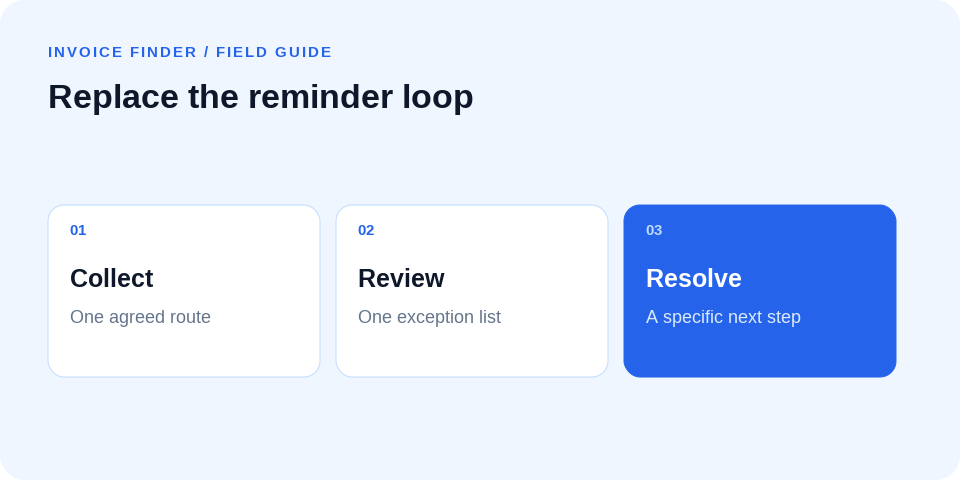
Agree one collection route and a monthly cut-off. Search for documents already available, then send a single exception list with a named owner and a specific next action.
Why clients forget to send invoices
Most missing-document problems begin before the reminder. A purchase happens on a phone, the receipt arrives in an email address nobody checks for bookkeeping, and the person paying is not the person assembling the monthly records. “Please send your invoices” leaves the client to work out which ones, where they are and what counts as finished.
Treat this as a handoff problem. Ask where business receipts actually arrive, who buys on behalf of the business and how supplier portals are accessed. An agreed route for each source is more useful than a longer reminder email.
Find the hidden cost of the reminder loop
The cost is not only the time spent writing an email. Work is paused, the same transaction is reviewed twice and a reply can create another question. You do not need an industry benchmark to see whether this is happening in your practice.
- Count unresolved document requests at the agreed cut-off.
- Note how often a transaction is reopened because the evidence is still missing.
- Separate “file not supplied” from “business purpose unclear”. They need different answers.
- Record the source of repeat gaps: staff cards, online portals, subscriptions or an unmonitored mailbox.
Use a small baseline from your own work. Avoid promising a fixed number of hours saved: client habits, transaction volumes and existing systems differ.
Choose a collection method that fits the client
| Method | Best use | Watch for |
|---|---|---|
| Selected forwarding | Low-volume email invoices | Documents arrive only when someone forwards them. |
| Dedicated document address | A consistent intake point | Staff and suppliers must know the address. |
| Upload folder or portal | Scans and documents outside email | Loose filenames and duplicate uploads need review. |
| Selective email rules | Known recurring suppliers | False matches and missed formats require checks. |
| Authorized document search | An invoice already in client email | Mailbox permission is a separate access decision. |
Pick a default, then keep one alternative for exceptions. Several equally “official” collection channels make it harder to tell whether a file is genuinely missing or simply in another place.
Set a monthly routine with one exception list
- Agree a collection date, review date and the client contact responsible for exceptions.
- Collect the records through the agreed intake route and compare them with the transactions being worked on.
- Build one exception list: supplier, date, amount/currency, document needed, owner and next action.
- Retrieve what you can from authorized sources before asking the client.
- Send one concise request for the remaining gaps and update the same list when replies arrive.
For example, a fictional design studio supplies its monthly statements but misses three software receipts. Search the authorized email or ask for those named receipts. Do not send a second general request for “all November invoices” when most of the work is already complete.
Use the monthly document checklist to make the handoff repeatable.
Automate capture; keep review in the workflow
Email rules can move recurring supplier documents into a collection route. A capture process can help receive new paperwork consistently. Neither removes the need to check the business, period, file quality and duplicates.
Coming soon: Invoice Finder takes the chase out entirely. Clients connect Gmail or Outlook once, preview what you’ll see and approve. AI then collects every invoice and receipt as it arrives, plus the last 18 months, and you never see their other email. See how it works.
If you set up Gmail forwarding, verify the recipient and test a narrow rule first. Google distinguishes selected-message filters from forwarding all new mail. See Google’s forwarding guidance and BillBjorn’s Gmail forwarding tool.
Measure a better process, not more reminders
After a collection cycle, review which documents were missing at the first check and which still needed a client reply. Look for a source you can fix: a supplier portal, a staff purchasing habit or receipts arriving at a personal address.
Keep the tone collaborative. “These two items are still open; here is exactly what we need” is easier to answer than “we are still waiting for your paperwork”. For ready-to-use wording, use the missing invoice request templates.
Provider instructions checked on 25 November 2026: Google: selective forwarding. Menu labels can vary by account, region and interface.